[Home] [CSHS] [Membership] [Area History] [Photographs] [Gift Store] [Museum Project] [Area Information]
PHOTOGRAPHS
EARLY LOGGING
Western Pioneers arrived in the Pine Ridge area in 1853 to harvest the trees to meet the demand for lumber following the California gold rush. James Hultz established a steam sawmill in 1854 in the vicinity of the area now known as Meadow Lakes. Tollhouse Road, started by the Woods Brothers in 1866 and completed by John Humphreys provided the means for wagons to haul supplies and teams of mules and horses to skid heavy equipment up steep grades to the forest above Pine Ridge. From this beginning logging operations increased dramatically. According to The Sawmill History of the Sierra National Forest 1852 to 1940 there have been a total of 239 mills in operation in the area. The following pictures give you a flavor of logging operations that began well over a century ago.
BIG WHEELS - Big wheels drawn by teams of horses were used in the early logging years to move logs from the woods. This method worked only on relatively level terrain, therefore the big wheels were not really suited to the steep terrain found in the Sierra and the big wheels gave way to more efficient ways to move logs to the sawmills.
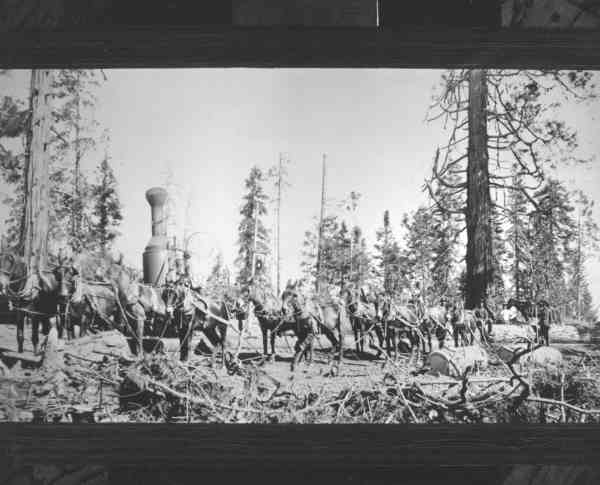
A FIVE-HITCH MULE TEAM - Early logging in the last half of the 19th century was done primarily by man and animal power. Here is a mule team is dragging logs to steam donkey engine that can move logs more efficiently by mechanical power.
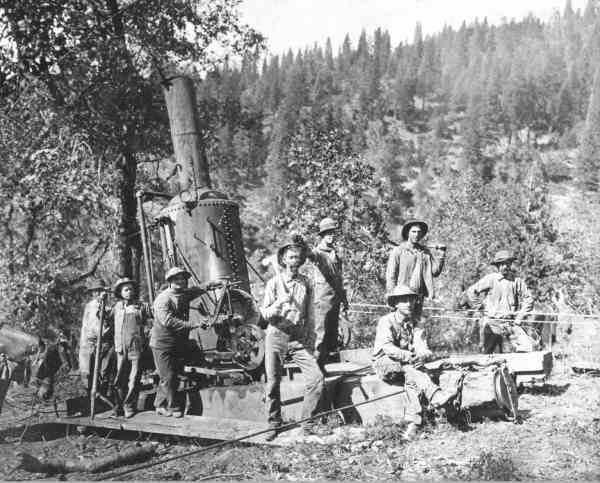
STEAM DONKEY ENGINE - John Dolbeer, a naval engineer, obtained a patent in 1882 for his logging engine patterned after a ships auxiliary engine called a "donkey". The donkey engine brought steam power to the forest to gradually replace the oxen, mules and horses to move the logs from the rugged terrain of the Sierra Nevada. The donkey engine could move itself through the forest by using its steam power and winch to skid the donkey to a new location.
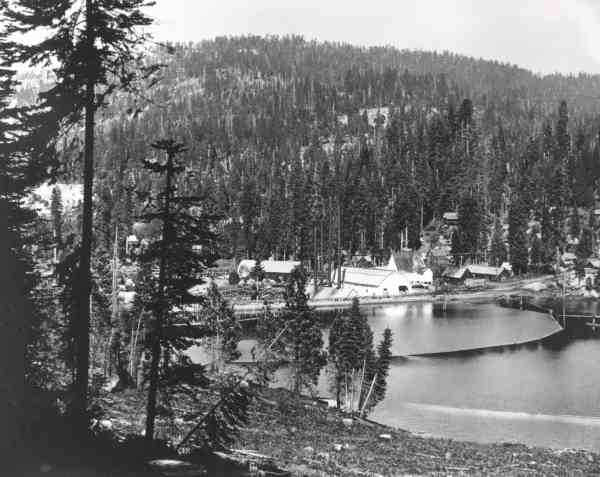
THE SHAVER DAM and MILLPOND - The Shaver Dam. MillPond, and Mill are visible in this photograph. Construction started on this giant mill in 1892 and by 1900 it was the major economic force in eastern Fresno County. The site of the mill is located within the water impounded behind the "new" dam completed in 1927. The mill site is 120 feet below the high water mark of the current dam.
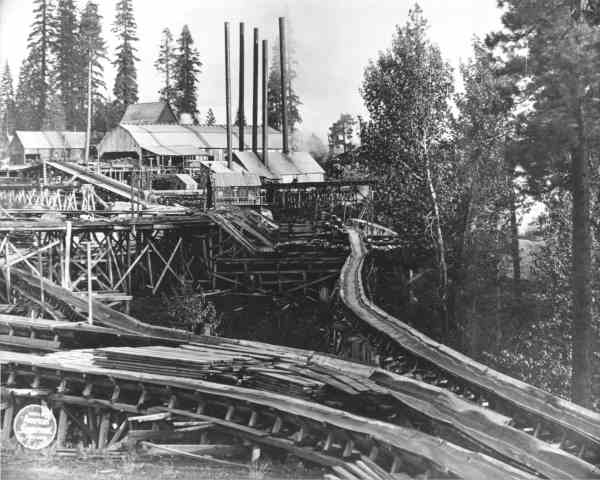
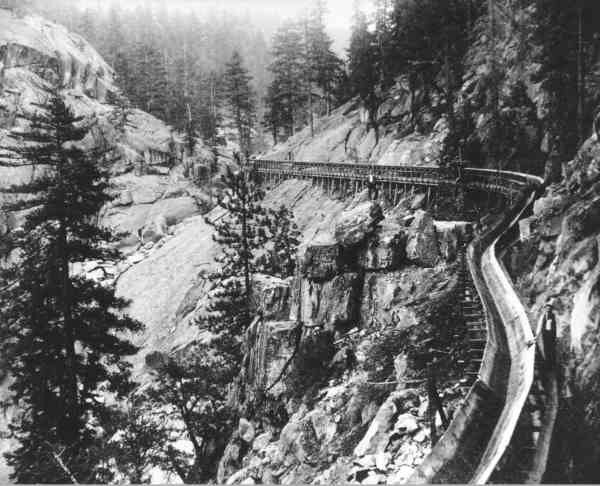
THE SHAVER MILL and FLUME - This view of the mill is from below the dam. Drying rough sawn lumber from the mill may be seen on platforms next to the network of flumes. Once the lumber is dry enough to float it will be placed in the flume and floated to the Clovis finishing mill 42 miles away in the San Joaquin Valley and over 5300 feet below the Shaver Mill.
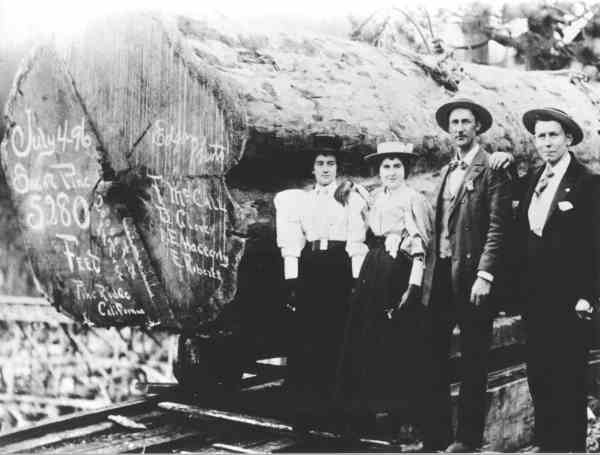
FOURTH OF JULY 1896 AT SHAVER LAKE - Two couples, all dressed up for a 4th of July celebration at the Shaver Mill. The large log with their names on the end is resting on a cart to carry it into the mill.
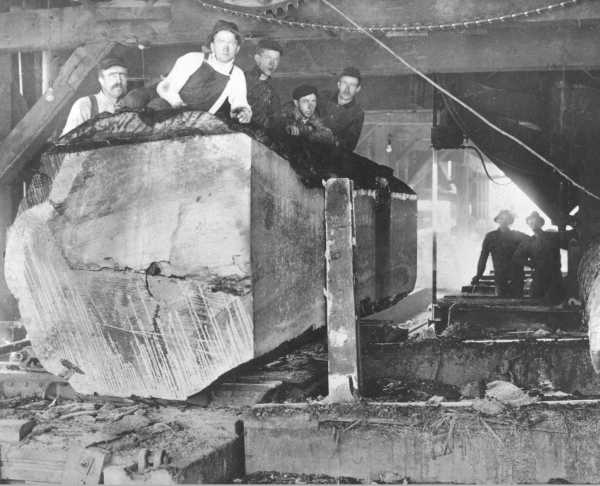
THE SHAVER BAND SAW - Inside the Shaver Mill logs were cut into rough lumber to be floated down to the Clovis finishing mill. Originally the mill used big double circular saws, however the circular saw could not handle large logs without first splitting them with black powder. In 1901 a band saw replaced the circular saw which reduced waste and improved the efficiency of the mill.
THE SHAVER TO CLOVIS FLUME - This view of the 42-mile long lumber flume is located just below the Shaver Mill. The large rock to the left is "Shaver Rock" , clearly identifiable today just to the west of State Highway 168 on the sharp curve below the present Shaver Dam. This area is known as "Devil’s Canyon" through which Stevenson Creek, the natural outlet of Shaver Lake, flows to the San Joaquin River in a series of spectacular falls in a vertical drop of over 2,600 feet .
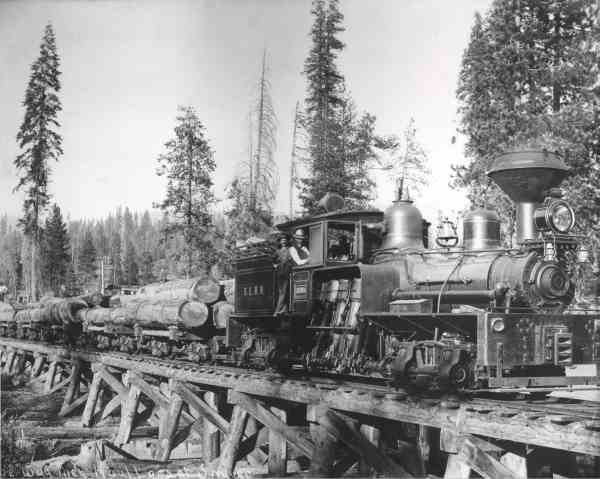
THE SIERRA - The Shaver Mill purchased two Lima Shay locomotives, the first in 1902 to bring sawlogs to the millpond from the Dinkey Creek area some 12 miles distance. Pictured is the "Sierra", the first of the Shays, crossing a trestle with a load of logs on the way to the log dump at Shaver Mill Pond located to the west of the present location of the Shaver Lake Fishing Club.
THE SAN JOAQUIN AND EASTERN RAILROAD
Following the turn of the century it was the need for electrical power that brought the next dramatic change to the Central Sierra. John Eastwood, a brilliant civil engineer for the city of Fresno, devised a plan for a hydroelectric network consisting of dams, powerhouses, tunnels, penstocks and transmission lines to fulfill the need for electricity. It was Henry Huntington who was able to turn Eastwood’s dream into reality, for Huntington had the money and the need for electricity to power his Los Angeles streetcar business. Huntington acquired control of Pacific Power and Light which later merged with Southern California Edison. The Big Creek Project, started in 1911, embarked on a major construction effort. Before any hydroelectric facilities could be built a railroad had to be constructed to support the project. A 52-mile mountain railroad was built in just 157 days. From El Prado, just north of Clovis to Cascada later renamed Big Creek, there were over 1000 curves and 43 trestles as the railroad made its way from the valley floor to an elevation of 4,881 feet above sea level. The San Joaquin and Eastern Railroad supported the Big Creek project until it was abandoned and scrapped in 1933.
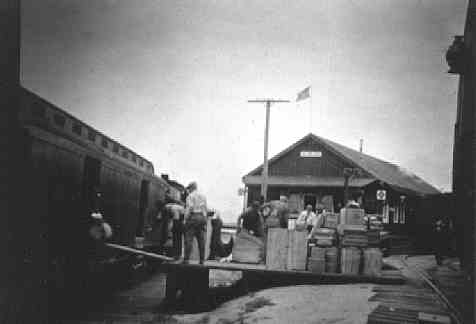
EL PRADO STATION - Freight from a Southern Pacific train on the left is being unloaded at El Prado for transfer to a SJ&E train to the right of the station.
to Sierra National Forest. A huge mill (insert 3 pictures of mill) was built in 1893 by Charles B. Shaver and Lewis P. Swift at Stevenson Meadow which is now Shaver Lake. They built a dam across Stevenson Creek to provide a millpond for their logs and water to float sawn lumber down a 42-mile flume (insert picture of the flume) to the finish mill in Clovis on the valley floor. This was a much faster way to get the lumber down the mountain, 6 hours by flume compared to a three-day trip by wagon down Tollhouse Grade. The Shaver Mill included a standard gauge railroad (insert picture of the Sierra) to haul the logs from the woods to the millpond. Eventually the mill processed 450 million board feet of lumber, enough to build a city the size of San Francisco.
HYDROELECTRIC POWER (under construction)
the water of Big Creek which now forms Huntington Lake at an elevation of 7,000. Water is delivered by tunnel and high strength steel penstock imported from Germany to Powerhouse No. 1, 2,000 below Huntington Lake. The generated electricity travels over a 230-mile transmission line to Los Angeles and by 1913 was powering Henry Huntington’s. In 1926-27 Shaver Lake was enlarged from a 5,000 acre feet to 135,000 acre foot hydroelectric reservoir making it the largest body of water in the Big Creek system.
While the hydroelectric project provided electricity to Los Angeles, it also provided a recreation wonderland to those that love and vacation in the central Sierra.
[Home] [CSHS] [Membership] [Area History] [Photographs] [Gift Store ] [Museum Project] [Area Information]